When the Australian Government endorsed 15 data centre projects worth $51.9 billion for prioritised government support in early 2026, it was sending a clear signal: compute infrastructure is no longer just an IT question. It's a matter of national sovereignty.
The term "sovereign AI compute" is appearing more frequently in government policy documents, enterprise technology strategies, and investment announcements. But what does it actually mean, why does it matter, and what is Australia currently doing — and not doing — to build it?
What Is Sovereign AI Compute?
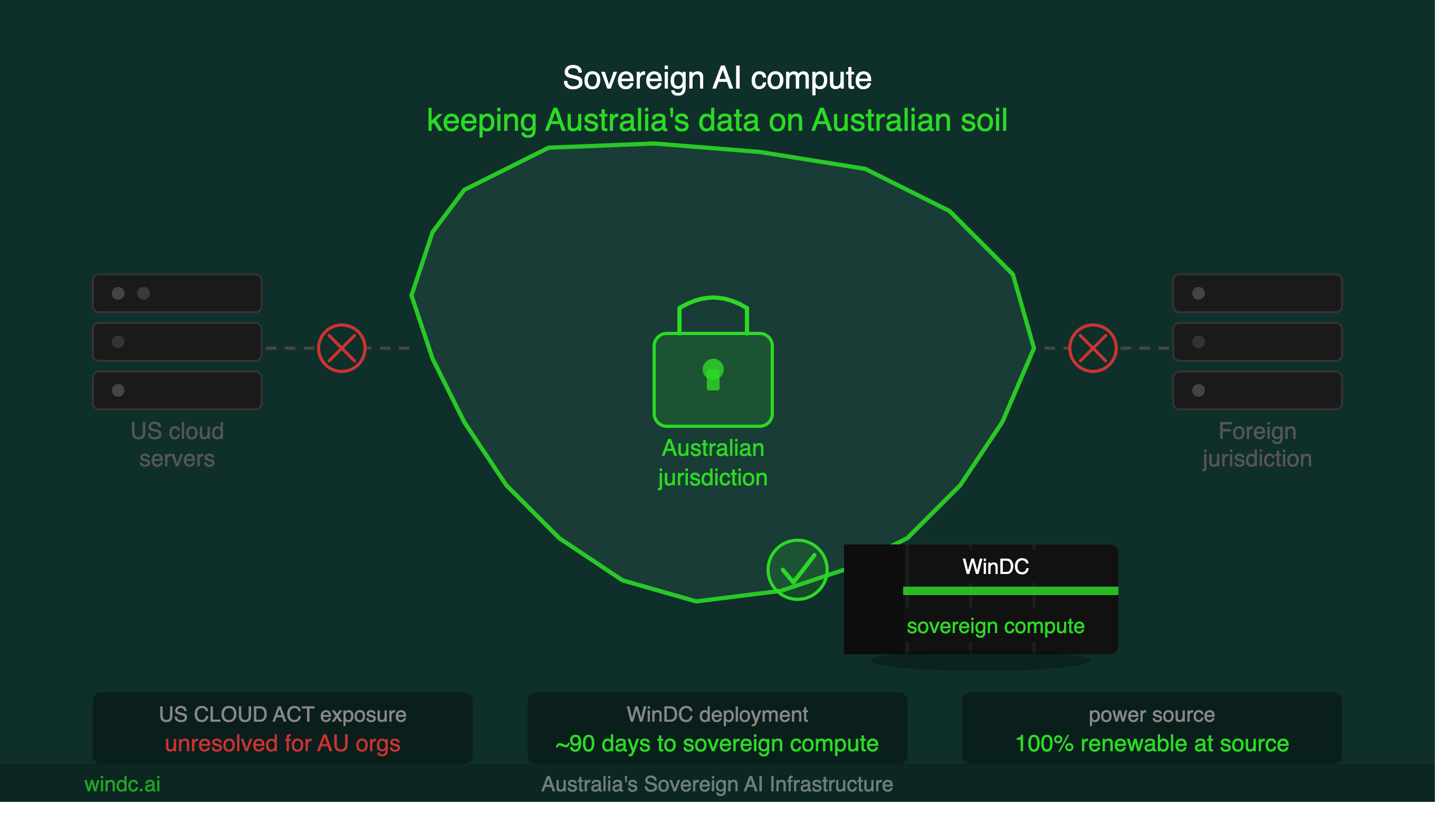
Sovereign AI compute refers to artificial intelligence infrastructure that is owned, operated, and physically located within a country's own borders — under its own legal jurisdiction, regulatory framework, and control.
It's the difference between running your AI workloads on a server in Sydney that is operated by an Australian entity under Australian law, versus running those same workloads on a server in Virginia, Oregon, or Dublin that happens to be operated by an American company under US law.
The distinction matters for several interconnected reasons: data privacy, national security, regulatory compliance, economic competitiveness, and the ability to develop and control AI capability that reflects Australian values and serves Australian interests.
Sovereign AI compute is not just about where a server sits. It's about who controls it, who can access the data on it, which laws govern it, and whether Australia has the capacity to sustain and develop AI capability independently — without being dependent on foreign infrastructure providers for something that is rapidly becoming as fundamental as electricity.
Why Is Data Sovereignty Important for AI?
AI systems are fundamentally data-intensive. Training a large language model requires processing enormous datasets. Running inference — the process of actually using an AI model — requires continuous access to compute infrastructure. And the data involved in both processes can be extraordinarily sensitive: medical records, financial transactions, legal documents, government communications, defence intelligence, and personal information at population scale.
When that data and those workloads sit on infrastructure controlled by a foreign company in a foreign jurisdiction, Australian organisations face a range of risks that are difficult to fully mitigate.
Legal jurisdiction. US cloud providers operating in Australia are still subject to US law — including the CLOUD Act, which allows US authorities to compel disclosure of data stored by US companies regardless of where that data physically resides. For Australian government agencies, defence contractors, healthcare organisations, and financial institutions, this creates a genuine and unresolved compliance exposure.
Commercial dependency. Relying on foreign hyperscalers for critical AI infrastructure means accepting pricing set in USD, service terms dictated by the provider, and the risk that access could be restricted, repriced, or restructured at any time. As AI becomes more central to organisational operations, this dependency becomes a significant commercial and strategic risk.
Technology control. If Australia's AI capability depends on infrastructure and models owned by foreign companies, Australia has limited ability to shape the development of AI in ways that reflect Australian policy priorities, cultural values, or economic interests. Sovereignty includes the ability to make independent choices — about what to build, how to govern it, and who has access to it.
Where Australia Currently Stands
Australia's sovereign AI compute position is, at present, weak relative to the country's economic standing and strategic ambitions.
The vast majority of AI compute consumed by Australian enterprises, government agencies, and research institutions runs on hyperscaler cloud infrastructure — predominantly AWS, Microsoft Azure, and Google Cloud — with data processed in data centres operated by US companies under US corporate governance.
Australia does have data centres on its soil — hyperscaler regions in Sydney, Melbourne, and Canberra have grown significantly in recent years. But colocation in a foreign-operated facility is not the same as sovereign infrastructure. The physical location of the server matters far less than who owns and controls it, which law governs it, and who can compel access to it.
The government's $51.9 billion in endorsed data centre projects represents a significant step — but much of that investment is still flowing to foreign operators building and operating their own facilities on Australian soil. Australian-owned, Australian-operated AI compute infrastructure at scale remains a largely unmet need.
There are structural reasons for this gap. Building conventional data centres is slow and expensive. The grid is constrained. The skilled workforce is limited. And the economics of competing with hyperscalers on their own terms — cloud pricing, global scale, platform breadth — are difficult for domestic operators to match.
The Renewable Energy Angle
One factor that distinguishes Australia's sovereign compute opportunity from most other countries is the scale of its renewable energy resource.
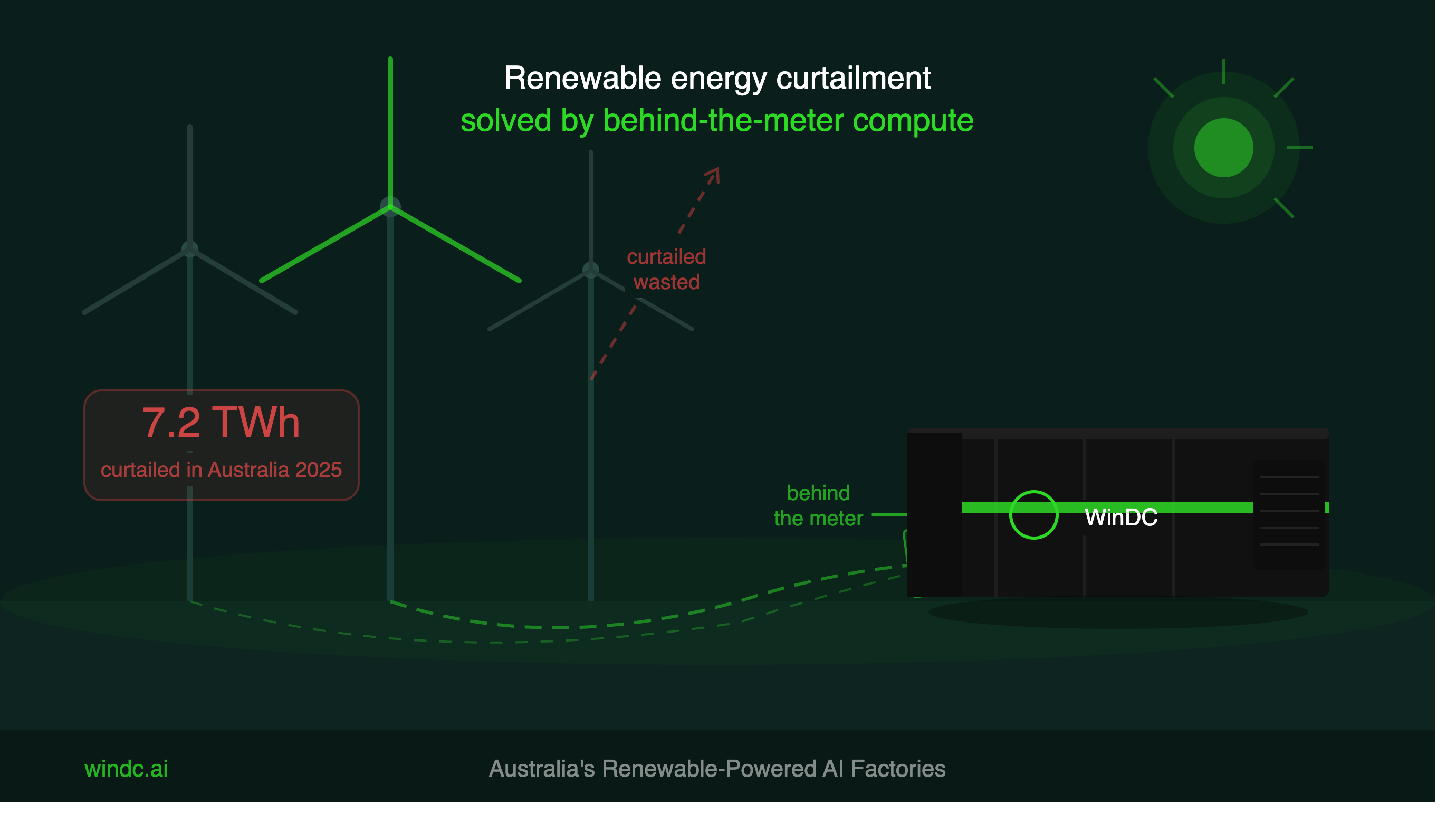
Australia has among the best solar and wind resources in the world. The country is generating more renewable electricity than ever before — and curtailing more of it than ever before, because transmission infrastructure can't carry it from where it's generated to where it's consumed.
This creates a structural opportunity that most countries don't have: the ability to deploy AI compute infrastructure at renewable generation sites, behind the meter, consuming electricity that would otherwise go to waste, at dramatically lower cost than grid-connected alternatives.
Sovereign AI compute built on stranded renewable energy isn't just strategically sound — it's economically compelling. It delivers compute at up to 50% lower cost than hyperscaler pricing, with zero Scope 2 emissions, on Australian soil, under Australian control.
This is the model WinDC's AI Factories and modular data centres are built around — deploying rapidly at renewable generation sites across Australia, turning stranded energy into sovereign compute capacity.
What Sovereign AI Compute Enables
The case for sovereign AI compute isn't just defensive — it's not only about avoiding the risks of foreign dependency. It's also about what becomes possible when a country has genuine AI infrastructure capability of its own.
Government and defence. AI workloads handling classified information, citizen data, and national security intelligence can only be safely processed on sovereign infrastructure. As AI becomes more embedded in defence capability, border management, intelligence analysis, and critical infrastructure protection, the need for sovereign compute becomes non-negotiable.
Healthcare. Training AI models on Australian medical records — to improve diagnostics, drug development, and population health management — requires infrastructure that meets Australian privacy law. Sending that data offshore to train models on foreign infrastructure creates compliance risk and data sovereignty problems that most healthcare organisations are not yet equipped to navigate.
Financial services. AI systems making credit decisions, detecting fraud, and managing investment portfolios at scale need to operate under ASIC oversight and within Australian regulatory frameworks. The data involved is among the most sensitive in the economy.
Research and innovation. Australia's universities and research institutions are world-class. Building sovereign AI compute capacity creates the infrastructure foundation for Australian AI research to develop into globally competitive commercial applications — keeping the intellectual property, the talent, and the economic value onshore.
The Speed Problem
One of the central challenges in building sovereign AI compute is that the window to act is now — and the traditional tools for building infrastructure are too slow.
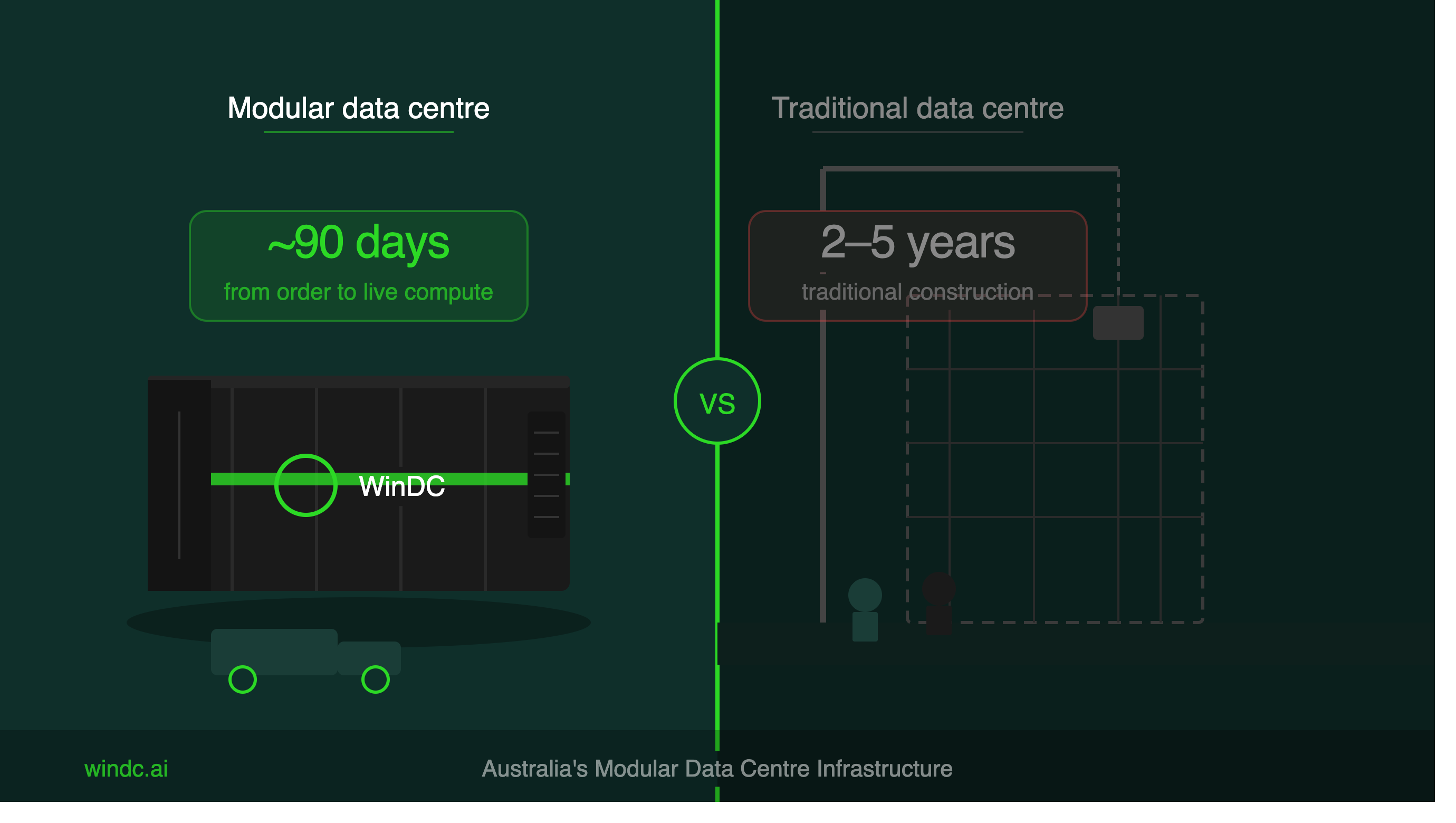
Conventional data centre construction takes two to five years. By the time a purpose-built facility breaks ground, receives grid connection, and completes construction, the AI landscape will have evolved significantly. The organisations that needed sovereign compute in 2025 won't be waiting until 2030 for a conventional facility to come online.
This is where modular infrastructure changes the equation. Deploying modular data centres at renewable generation sites — pre-built, pre-tested, commissioned in approximately 90 days — creates a path to sovereign AI compute capacity at the pace the market actually requires.
It's not a permanent substitute for long-term infrastructure investment. But it's the only credible fast-path option available to Australian organisations that need sovereign compute capability now rather than in half a decade.
What Australian Organisations Should Be Asking
If you're an enterprise, government agency, research institution, or AI platform operating in Australia, sovereign compute is a question worth putting on the agenda now — not when a compliance incident forces it.
The questions to be asking are:
Where is our AI compute physically located, and under whose legal jurisdiction?
Which laws govern our data when it's being processed by AI systems? Is the CLOUD Act exposure something our legal and compliance teams have formally assessed?
What would it cost — in commercial, regulatory, and reputational terms — if access to our AI infrastructure were restricted, repriced, or disrupted?
What would it take to move a meaningful proportion of our AI workloads to sovereign Australian infrastructure — and how long would that take?
If those questions don't have clear answers, the conversation about sovereign AI compute is overdue.
To discuss sovereign AI infrastructure options for your organisation, get in touch with WinDC.
WinDC builds and operates modular, renewable-powered AI factories and data centres across Australia. Deployed in ~90 days. Zero Scope 2 emissions. Sovereign compute at scale.