
Australia's data centre market is growing faster than at almost any point in its history. Demand for compute is accelerating — driven by AI adoption, cloud migration, and the data sovereignty requirements of government and enterprise — and organisations across every sector are asking the same question: what's the fastest, most cost-effective way to get infrastructure in the ground?
For most of the industry's history, the answer has been the same: build a traditional data centre. Commission an architect. Procure a site. Apply for grid connection. Wait.
That model is increasingly being challenged by a different approach — modular data centres — and the difference between the two is more significant than most people realise.
What Is a Traditional Data Centre?
A traditional data centre is a purpose-built, permanent facility constructed on-site. It typically involves civil construction, specialist electrical and mechanical engineering, custom cooling design, permanent grid connection, and years of planning and approvals before a single server goes live.
Traditional data centres are built to last decades. They're designed around fixed capacity assumptions and expanded through additional construction phases, each requiring its own planning cycle. The power and cooling infrastructure is engineered specifically for the building, making it difficult and expensive to adapt if workload requirements change.
In Australia, traditional data centre construction typically takes between two and five years from site acquisition to commissioning. The cost of a mid-scale facility can run to hundreds of millions of dollars before any hardware is installed.
For large, established operators building hyperscale campuses in metropolitan areas with reliable grid access, this model makes sense. For most other organisations — and for almost any use case involving remote deployment, speed to market, or capital efficiency — it increasingly does not.
What Is a Modular Data Centre?
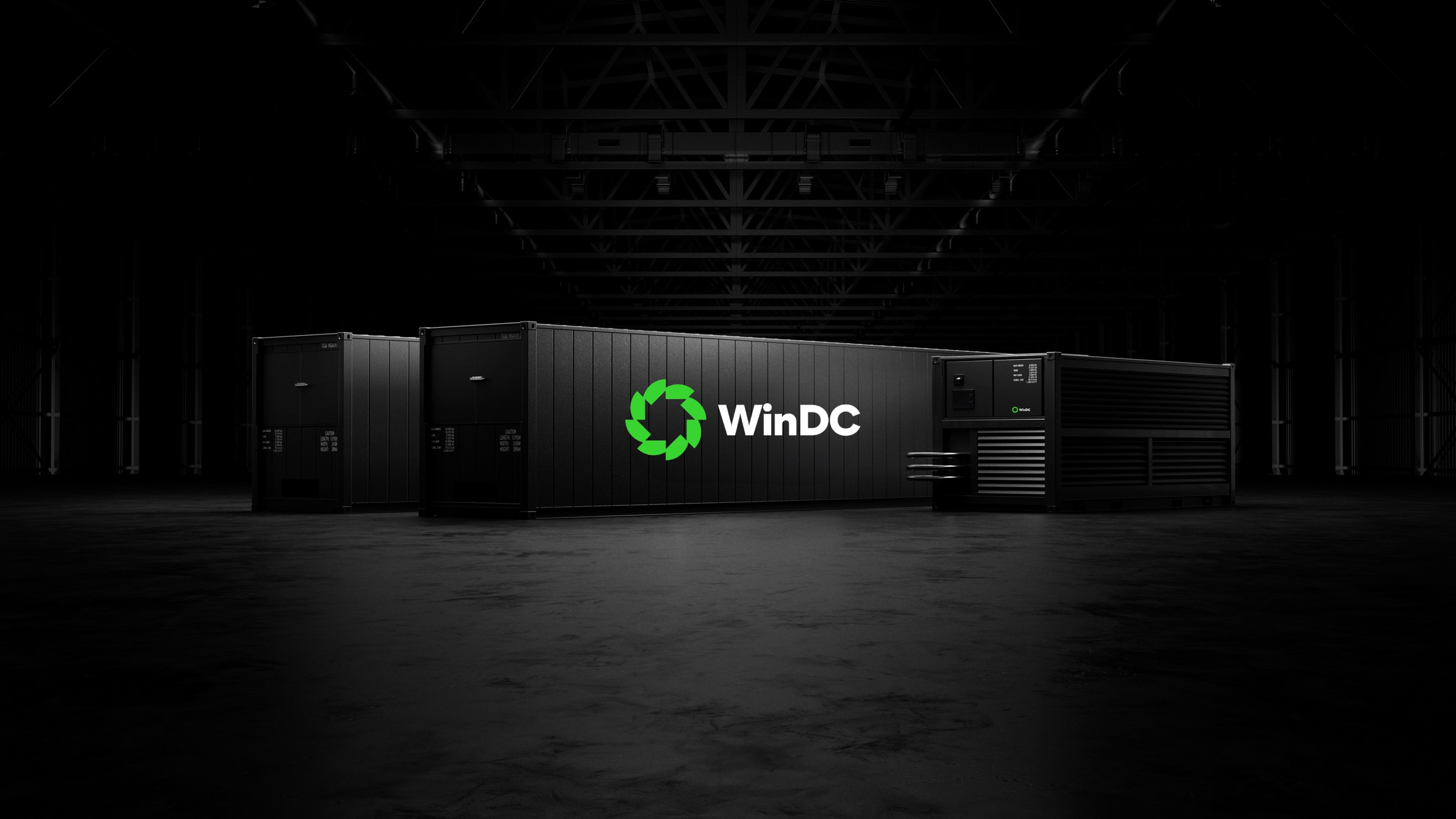
A modular data centre is a prefabricated, self-contained compute facility built in a controlled factory environment and shipped to its deployment site ready to operate.
Rather than constructing a building around the IT infrastructure, modular data centres package the infrastructure — servers, cooling, power systems, networking — into an ISO-conformant container. The module is built, tested, and commissioned in the factory before it ever leaves. On site, it connects to power and network and begins operating.
WinDC's modular data centres are ISO-conformant containerised units delivering up to 1.8MW of high-density compute per module, with configurations optimised for GPU, CPU, or mixed workloads. They include integrated liquid cooling, N+1 redundant power, and fleet management — all factory-built to exacting standards.
The modular approach means capacity can scale incrementally by adding pods, the infrastructure can be relocated if requirements change, and deployment is possible in locations where traditional construction simply isn't viable — remote sites, renewable energy locations, mining operations, regional campuses, and defence facilities.
The Key Differences
1. Deployment Time
This is where the gap is most dramatic.
A traditional data centre takes two to five years to plan, approve, construct, and commission. That timeline accounts for site acquisition, building approvals, grid connection applications, civil construction, fit-out, and testing. In Australia, where grid connection timelines are under significant pressure, the infrastructure approvals alone can take longer than expected.
A WinDC modular data centre deploys from site assessment to live operations in approximately 90 days.
For organisations that need compute capacity now — to support an AI deployment, a regulatory requirement, a new operational site, or a time-sensitive project — the difference between 90 days and five years is not a minor consideration. It determines whether the project is viable at all.
2. Capital Cost and Financial Flexibility
Traditional data centres require enormous upfront capital expenditure. The building, the electrical and mechanical systems, the cooling plant — all of this must be built to full capacity from day one, even if demand grows into it over years.
Modular data centres change the financial model. You deploy what you need, when you need it. Additional capacity comes from adding modules — not from construction programmes. This means lower initial capital outlay, faster return on investment, and the ability to scale in line with actual demand rather than forecast demand.
WinDC modular data centres also benefit from significantly lower operational power costs. Deploying behind the meter at renewable generation sites — where power is drawn directly from solar, wind, or hydro sources before it reaches the grid — eliminates transmission costs and delivers energy at dramatically lower rates than grid-connected alternatives. The result is compute delivered at up to 50% lower cost than comparable hyperscaler or traditional data centre infrastructure.
3. Location Flexibility
Traditional data centres require proximity to reliable grid infrastructure, skilled construction labour, and — in most cases — major population centres. They are fundamentally tied to the places where grid power is available and construction is practical.
Modular data centres have no such constraints. WinDC modules are ISO-conformant and fully intermodal — they ship by truck, rail, or sea to any location. They can be deployed at remote mine sites, renewable energy generation facilities, regional government campuses, defence installations, and agricultural operations. If requirements change, the infrastructure can be relocated.
This flexibility matters enormously in Australia, where the most abundant renewable energy resources — and the greatest need for compute infrastructure — are often in locations far from established grid networks and urban centres.
4. Scalability
Traditional data centres are designed for a fixed capacity, expanded through additional construction phases. Each phase requires planning, capital, and time. Scaling is inherently lumpy and slow.
Modular data centres scale by adding pods. Each new module adds up to 1.8MW of compute capacity with no disruption to existing operations, no construction programme, and no multi-year planning cycle. You add capacity when you need it, in the increments you need it.
5. Carbon Footprint
Traditional data centres draw power from the grid, which in Australia still carries significant carbon intensity despite the rapid growth of renewable generation. Even facilities that purchase renewable energy certificates (RECs) or carbon offsets are not necessarily running on clean power — they're running on grid power and accounting for it differently.
WinDC modular data centres deploy at renewable generation sites and draw power behind the meter, directly from the source. Every module runs on 100% renewable energy with zero Scope 2 emissions — verified in real time through Grokens, WinDC's carbon attestation platform, at the GPU-hour level.
For organisations with serious ESG commitments or government reporting requirements, the difference between verified zero-emission compute and offset-based accounting is significant.
When Does Each Model Make Sense?
Traditional data centres still make sense in specific circumstances: large, established operators building permanent hyperscale campuses in metropolitan areas with existing grid infrastructure and multi-decade demand certainty. If you're NEXTDC or Equinix, the traditional model is your business.
For almost every other use case — enterprise organisations needing on-premises compute, renewable energy operators monetising stranded power, government and defence agencies requiring sovereign infrastructure, research institutions needing affordable GPU capacity, or any organisation needing compute at speed — modular data centres are the better answer.
The Australian market is at an inflection point. <cite index="3-1">The country's data centre market was valued at USD 4.22 billion in 2025 and is projected to nearly double to USD 9.02 billion by 2031.</cite> The organisations that move fastest to deploy sovereign, cost-effective, renewable-powered compute infrastructure will have a significant advantage over those waiting years for traditional builds to complete.
WinDC's Modular Data Centre Approach
WinDC was built specifically to solve the problems that traditional data centre development cannot address: speed, cost, location flexibility, and clean energy.
Our modular data centres are factory-built, ISO-conformant, and operational in approximately 90 days. They deploy at renewable generation sites across Australia, delivering compute at up to 50% lower cost than hyperscaler alternatives, with zero Scope 2 emissions verified through Grokens.
They support the full spectrum of workloads — from AI training and inference through our AI Factories offering, to enterprise IT, high-performance computing, and government and defence applications.
If you're evaluating modular data centre deployment for your organisation, get in touch to discuss your requirements.
WinDC builds and operates modular, renewable-powered data centres across Australia. Deployed in ~90 days. Zero Scope 2 emissions. Sovereign compute at scale.