.png)
The partnership between WinDC and Armada began with a simple observation: the future of artificial intelligence will not be constrained by chips, but by power.
Across Australia and much of the world, renewable energy generation is expanding faster than the infrastructure needed to use it. Solar and wind farms are frequently curtailed, transmission networks are congested, and new hyperscale data centres can take many years to permit, connect and construct. At the same time, the demand for AI infrastructure is accelerating at a pace the traditional data centre industry cannot easily match.
WinDC had been studying this intersection for several years. As AI workloads continued to grow exponentially, the company undertook an extensive evaluation of the emerging modular data centre market, examining whether portable, rapidly deployable infrastructure could bridge the widening gap between energy availability and digital demand.
In late 2023, shortly after Armada began to emerge on the global technology scene with Armada Edge Platform (AEP), the two companies connected. The alignment was immediate.
WinDC brought deep expertise in energy systems, renewable generation markets and the growing structural constraints of grid infrastructure. With AEP, Armada brought the ability to orchestrate compute at the edge and a globally recognised modular data centre architecture, engineered specifically for high-density compute and rapid deployment.
Together the companies recognised they were solving two halves of the same problem.
The traditional data centre industry builds fixed facilities and waits for power to arrive. The WinDC–Armada model moves full-stack computing platforms to where energy already exists.
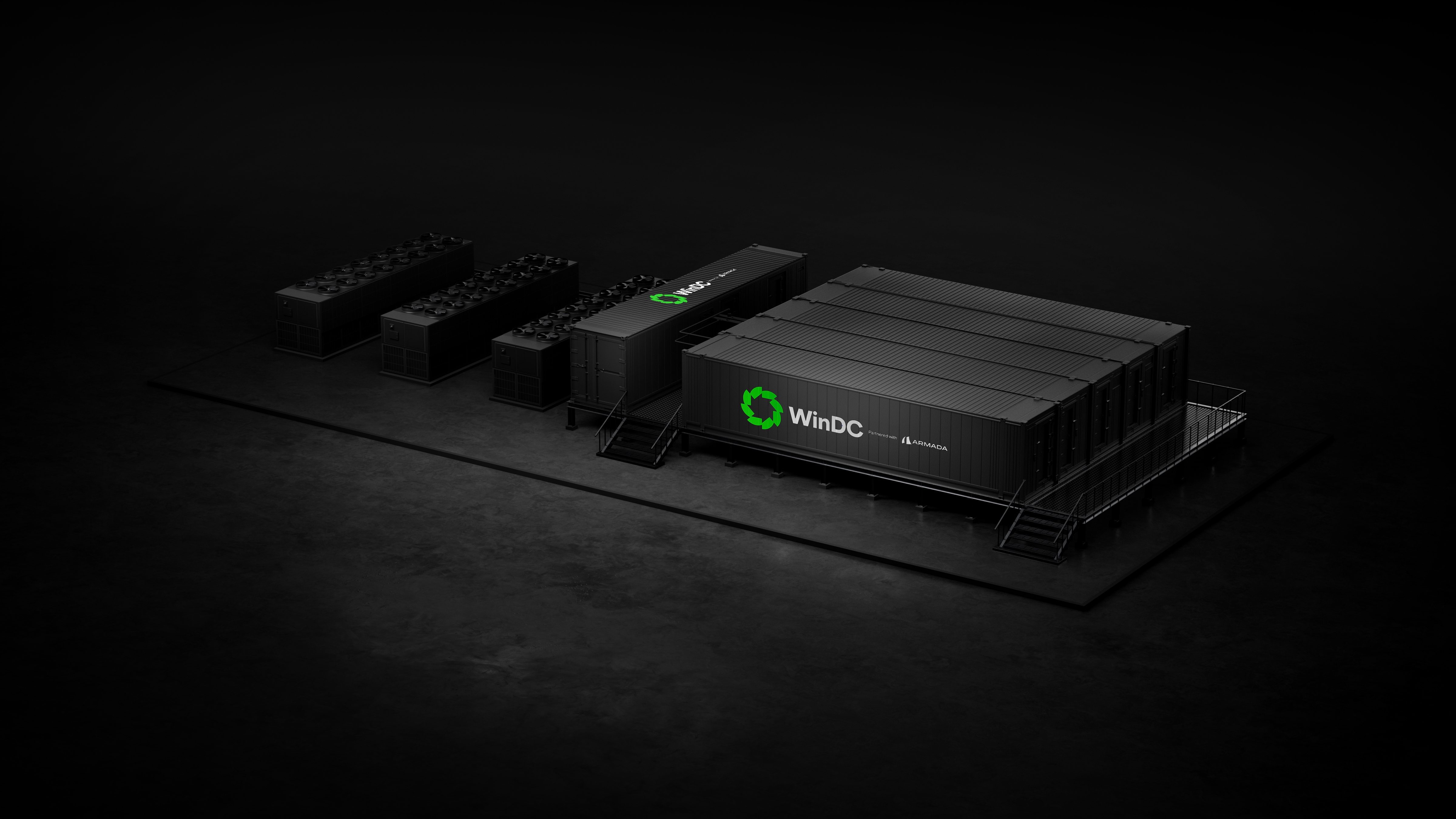
WinDC commissioned its first modular unit in January 2026 after a series of collaborative design cycles to ensure compatibility with the WinDC deployment plan. This milestone marked the transition from concept to operational infrastructure and validated the thesis that modular data centres could be deployed rapidly while meeting the engineering standards required for modern compute workloads. The deployment also built on Armada’s growing global track record, including successful projects in international markets such as the Middle East where rapid deployment and high-density compute infrastructure are increasingly in demand.
Since that first deployment, the collaboration between WinDC and Armada has continued to evolve alongside the rapid escalation in data centre density requirements driven by AI. Through ongoing joint requirement gathering, engineering and design refinement, module densities have increased significantly, approaching 2 megawatts of IT capacity per module.
This ability to combine high-density compute with modular portability and tight integration with renewable energy systems, has become a defining advantage of the partnership.
Traditional brick and mortar hyperscale data centres often take many years to develop, once land acquisition, grid approvals and construction are considered. They are also at risk of being immediately outdated given the speed at which manufacturers announce new compute. The modular platforms and renewable operating models developed through the WinDC–Armada partnership allow infrastructure to be deployed in a fraction of that time, enabling digital infrastructure to follow energy opportunity rather than waiting for transmission upgrades.
For Australia in particular, this model creates a unique opportunity. The country possesses some of the world’s most abundant renewable resources, yet much of that energy is geographically distant from traditional digital infrastructure hubs. By bringing edge computing directly to generation assets, energy can be converted into digital capability closer to where it is produced.
The partnership between WinDC and Armada represents a new category of infrastructure, one that sits at the convergence of energy systems and AI foundations.
It is infrastructure designed not around the constraints of traditional data centres, but around the realities of the modern energy system.