%20(1).png)
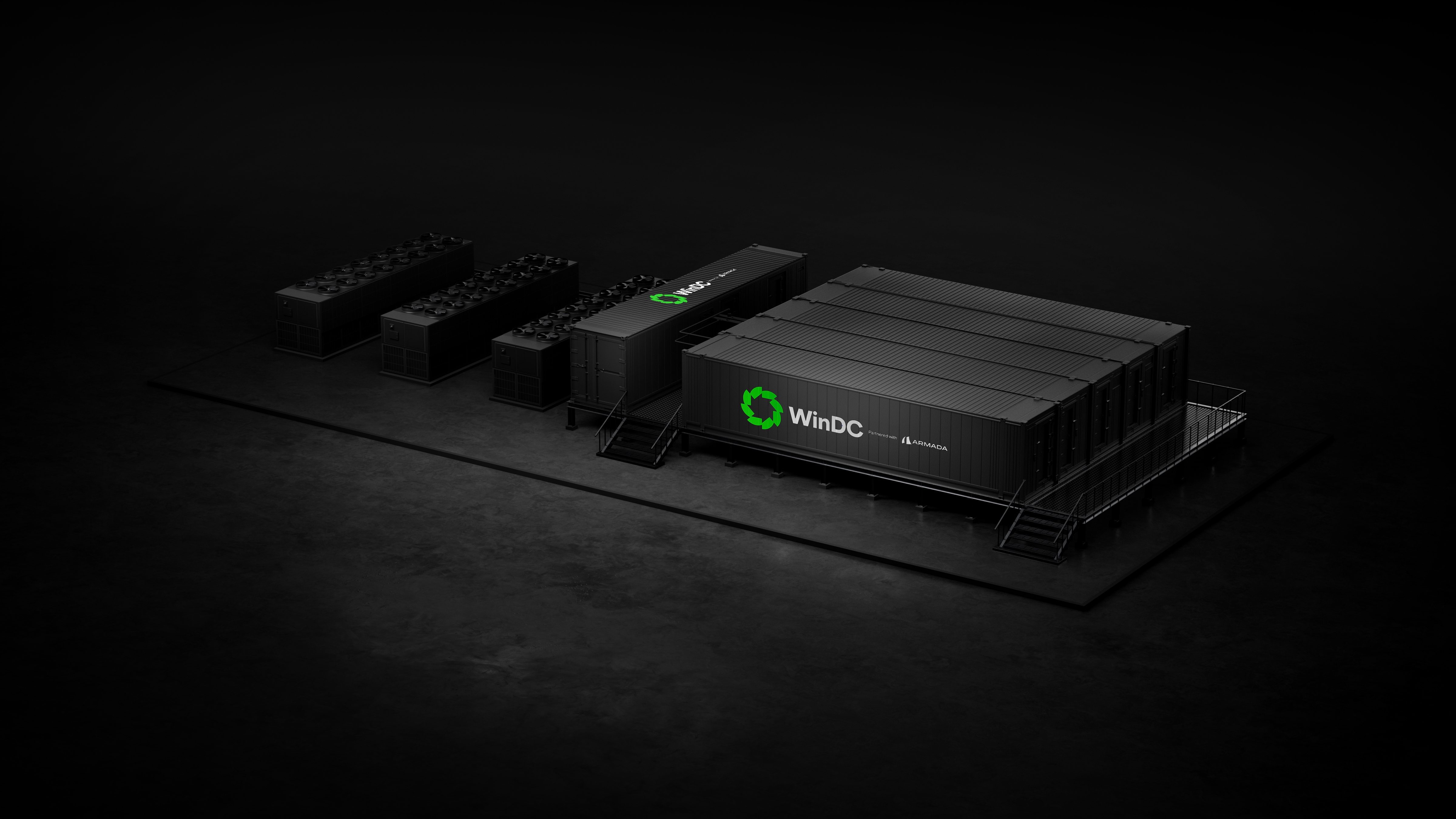
A major player has entered the data center space. A company called WinDC has launched Australia's first portable data center.
They're about the size of a shipping container and can be fully operational, they say within 90 days. Now, we know that data centers are vital to the future of artificial intelligence. They house critical IT infrastructure, like servers, storage, network equipment. Traditional data centers cost a fortune, but these ones only cost half the price.
If anyone's looking for one, they run on close to 100% renewable power and they're placed directly at solar, wind, and hydro sites. It means renewable power that often goes to waste is used. Prime, urban land is safe for housing instead of large data centers, and Australia is building its own AI capabilities.
Andrew Sjoquist is the founder and CEO of WinDC. He's live in the studio. Andrew, Good day.
Good day, Ben. Thanks for having us.
Congratulations.
Thank you.
I just asked on your way into the studio who came up with this idea? Look, it was a concept that I, that I sort of thought up about 15 years ago working in the energy space, we saw some constraints arising in the energy grid way back then
and we've just been waiting for the perfect storm to arise and here we are. That's a modest way of saying: "Ben. It was all my idea." It was all your idea. We got a great team around us as well.
What's your background?
My background's in IT services. So I founded a company about 25 years ago that delivers IT services to about 20% of the renewable energy industry on the east coast of Australia.
So we've had good insight into this market and what's been happening and now this is the right time to take it to the next step.
Why do we need data centers?
So data centers are the cornerstone of pretty much all our lives. Our voices now are going through a data center somewhere in the world, and so basically that underpins the economy
it's had huge impact into Australia's economy and certainly probably supported us through a recession perhaps in the last couple of years, and so that'll only continue to grow as we see artificial intelligence start to make its way into more of our lives and the need for compute and the power that drives that compute continues to grow.
We already had concerns about whether or not we had enough power to go around and then AI arrived and every time you are using artificial intelligence it's chewing up a lot of power, right? and that's one of the reasons we need the data centers, but data centers take a long time to build. They cost a lot of money.
Is that one of the restrictions, I suppose on the current way that we're doing data centers?
Yes. Speed is the new scale, as they say, so getting things out there quickly is really important, it's a global market, so we're competing against other countries around the world who are also building these AI factories.
But without power there is no ability to turn the lights on in these factories, and so it's really important that Australia as a country leads the way in terms of getting the out to market, but without power available, which has been a constraint in Australia because of the transmission grid and, and other elements and policy, it's been a challenge for traditional data centers to continue to scale. So we are changing the landscape, and we're taking the data centers from the cities where they traditionally have been out to where the energy is being generated, and thereby bypassing the transmission grid to achieve that speed.
So proximity helps close to the power source and it's portable, that's the other key difference. It is, so we can pick it up literally on the back of a truck. They take the form of a 40 foot shipping container, so we can drive them down the road and we can place them next to where they're needed, and so if the grid changes or the constraint changes, we can come back, we can pick them up, we can relocate them again and so that's been successful where we've deployed them in their test units there's a number of them deployed currently in the Middle East, which is a great spot to test for heat, similar to the Australian outback conditions, and that's been very successful. So our plan here is to roll out a full fleet across the country over the next couple of years and provide a new export industry to the world, so that the world's technology companies can run their AI in Australia. I'm getting a message from someone saying: "How do they know that they work?" Well, you know, they work because they're already operating in the Middle East. That's right. Correct. And when will we see them here in Australia?
So, the first ones just landed in Sydney this week. We have a launch coming up in a couple of weeks time, and after that they'll go out to renewable energy sites in New South Wales initially, and then we have a further fleet that's arriving later in the year, which a bigger scale as we continue to roll out the footprint.
True or false, both sides of politics are falling over themselves to get to you in this idea. Look, we've had very good engagement with both sides of politics. Certainly this is more of a nation building exercise as we see it. We really want Australia to be a leader, as we always have been in the past.
We've been a very innovative culture, we've designed a lot of good stuff: wifi, , black box, light recorders. There's a whole history of doing things exceptionally well. And so there's no reason why Australia shouldn't be able to participate. In terms of the position where we're at from an electricity and power perspective, we have wasted last year alone 7.2 terawatt hours worth of electricity in renewable energy assets.
That's enough to power 2 million homes. That's leftover power. Leftover power's not being used. Not utilized, not utilized. You'll be able to use all of it. That's the plan. Okay, so we've got one that's arrived now and it's going to be operational soon. Yep. And then how many do you expect are gonna be rolled out across the country?
So basically one of our advantages here, because we can deploy quickly, we don't have to put a lot of capital in and then see a return in two and three years time as the traditional data centers are occurring. So we'll align our orders on our factory line, which is set up, which can produce about two megawatts worth of capacity each week, and then basically roll that out in 90 days. So we have a time. And where are they being made? They're currently being made in Europe, however, in our contract with our OM manufacturer, we've had a made it at Australia Clause inserted. So we actually have the opportunity to bring these onshore into Australia and boost the manufacturing sector in Australia as well.
This is Andrew Sjoquist, the founder, and CEO of WinDC. One of the issues that always comes up around data centers is the amount of water that they require. Same goes for yours? So we've taken an approach with water, which is used in data centers for cooling, and usually you would use evaporative cooling in air cooled data center.
Now, compared to other infrastructure like swimming pools, data centers comparatively probably aren't as water hungry. Our approach here is to use closed loop liquid cooling. So we actually don't have a need for water at all. Is it too late for me to invest in this thing? We can talk about it afterwards.
Congratulations, and you're having talks at high levels in Canberra with a whole range of people. So Yeah, we certainly are, and we hope that they'll continue and it's an Aussie invention. That's right. Absolutely. Another one. Thanks very much for your interest and for your support. Yeah, no, congratulations.
Well, I mean, I reckon about 18 months ago, we hadn't really spoken much about data centers and ever since it's every second week that we've been talking about them. And every time anyone's using ChatGPT or any other AI tool, well we need more data, and these obviously are gonna be a game changer because they're mobile, they can be up and running within 90 days, and I love the fact that they use that power that's currently going to waste.
So, congratulations and we're looking forward to seeing how far it goes. Good, Ben. Thanks again. Andrew Sjoquist, an Aussie invention, the founder and CEO of WinDC.