.png)
The phrase "AI factory" is becoming one of the most used terms in the global technology industry. NVIDIA CEO Jensen Huang has used it repeatedly to describe the future of compute infrastructure. Governments from the US to Singapore are funding them. Australia's largest superannuation funds are investing billions into building them — predominantly offshore.
But what exactly is an AI factory? And what does it mean for Australia that we don't yet have sovereign capacity at scale?
The Term "AI Factory" — Where It Came From
Jensen Huang first popularised the term at CES 2024, describing a new category of infrastructure built specifically to produce artificial intelligence at industrial scale. His framing was deliberate: just as the Industrial Revolution required factories to turn raw materials into finished goods, the AI era requires factories to turn raw data into trained models, decisions, and intelligence.
The analogy is precise. A traditional factory takes inputs — steel, cotton, silicon — and produces outputs through a repeatable, high-throughput process. An AI factory does the same with data: ingesting it, processing it through GPU-accelerated compute, and producing trained models, inference outputs, and intelligence products at scale.
This is fundamentally different from what a conventional data centre does. Data centres store and retrieve data. AI factories produce something from it.
AI Factory vs Data Centre — What's Actually Different
The distinction matters more than it might seem, because the infrastructure requirements are completely different.
A conventional data centre is built around storage, networking, and general-purpose compute. It's optimised for availability, uptime, and data retrieval speed. Power density is typically low — around 5 to 10 kilowatts per rack.
An AI factory is built around GPU clusters running at maximum utilisation. It requires:
- High-density power — 50 to 200+ kilowatts per rack, far beyond what most data centres are designed for
- Specialised cooling — liquid cooling for GPU clusters that generate extreme heat at density
- Low-latency interconnects — high-speed fabric between GPUs to support distributed training across thousands of chips
- Enormous, stable power supply — AI training runs can't afford interruptions, and the power draw is massive and continuous
- Purpose-built software orchestration — to manage workloads, utilisation, and energy consumption across distributed GPU resources
This is why the world's biggest technology companies — Microsoft, Google, Meta, Amazon — are spending hundreds of billions of dollars building dedicated AI factory infrastructure. General-purpose data centres simply cannot support the workloads that modern AI requires.
Why Australia Has an AI Factory Problem
Australia is one of the world's leading renewable energy producers. It has strong research institutions, a sophisticated enterprise sector, and a government increasingly focused on sovereign AI capability. It should be well-positioned for the AI era.
And yet, as of mid-2026, Australia has no purpose-built, locally owned AI factory infrastructure operating at scale. The reasons are structural.
The grid can't keep up. Traditional data centre development requires connection to the national electricity grid, and the grid is under significant pressure. Transmission infrastructure is congested, new grid connections take years to approve, and the cost of grid-connected power is rising. Building a conventional AI factory in Australia through existing channels takes 2 to 5 years and hundreds of millions in capital — before a single GPU is switched on.
Renewable energy is being wasted. Australia curtailed 7.2 terawatt-hours of renewable energy in 2025, up from 4.5 terawatt-hours the year before. This is energy that solar farms, wind farms, and hydro facilities generated — but couldn't export to the grid because transmission capacity didn't exist to carry it. That figure is forecast to exceed 10 terawatt-hours in 2026. It represents billions of dollars in clean energy going to waste every year.
Enterprises are sending workloads offshore. Without local AI factory capacity, Australian enterprises are training models, running inference, and processing sensitive datasets on US-based hyperscaler infrastructure. This creates jurisdictional risk, compliance exposure, and pricing vulnerability — and it means Australian data is leaving Australian soil at the exact moment AI is becoming critical national infrastructure.
The Opportunity in the Problem
The combination of stranded renewable energy and unmet AI compute demand isn't just a problem — it's the setup for a new infrastructure model.
If you can deploy AI factory compute directly at renewable generation sites — behind the meter, consuming power that would otherwise be curtailed — you solve both problems simultaneously. The renewable operator gets a revenue stream from otherwise-wasted generation. The AI factory gets clean power at dramatically lower cost than grid-connected alternatives. And the grid benefits from reduced transmission demand.
This is the model that WinDC was built around: modular AI factories deployed at renewable energy sites across Australia, commissioned in approximately 90 days, running on 100% renewable power with zero Scope 2 emissions.
What Makes a WinDC AI Factory Different
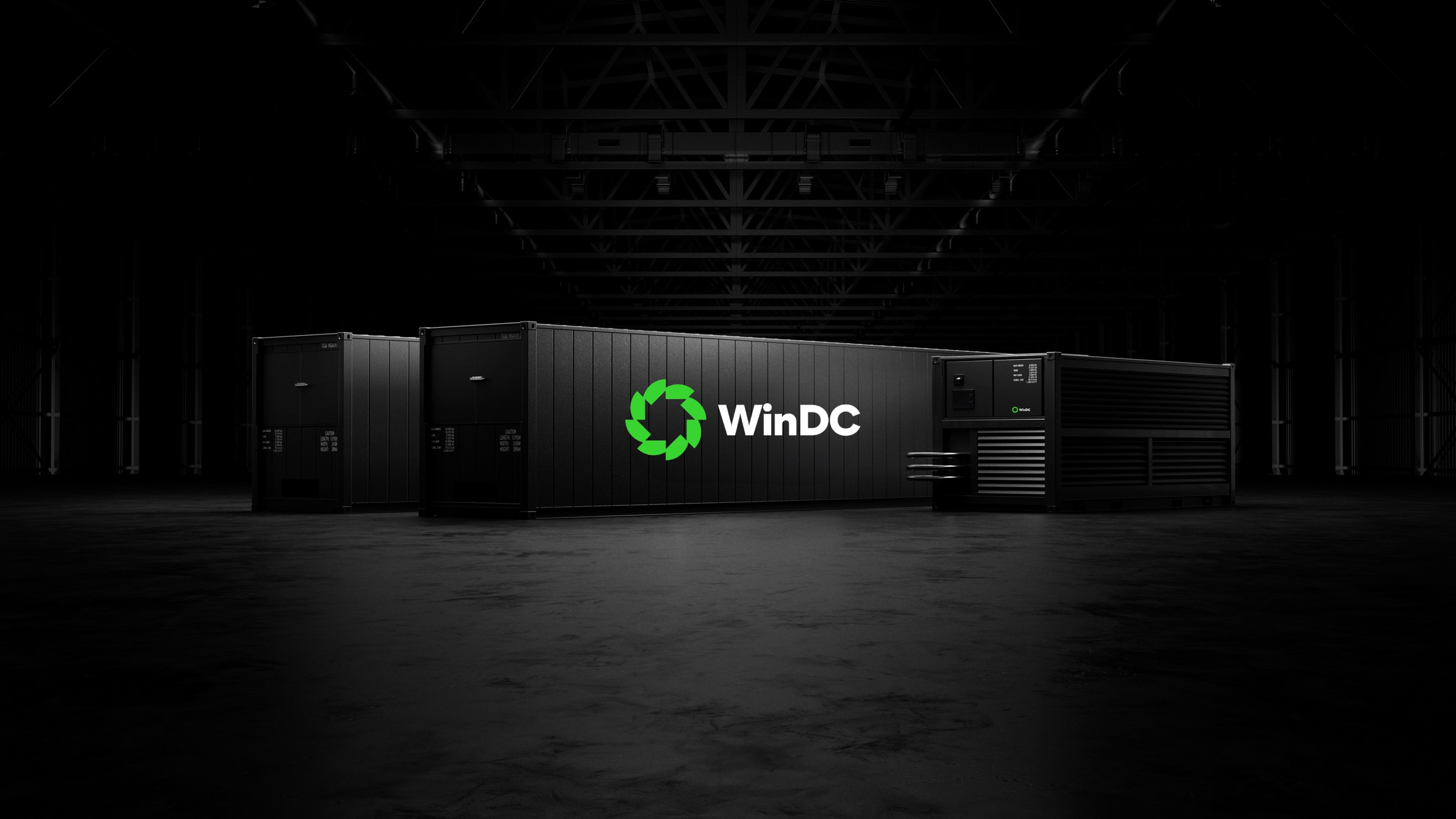
WinDC's AI factories are ISO-conformant containerised units — 20 or 40-foot modules factory-built with everything required for high-density GPU compute: liquid cooling, N+1 redundant power, fleet management systems, and hardware-agnostic GPU support for NVIDIA and AMD architectures.
The key differences from conventional AI factory development are:
Speed. From site assessment to live AI workloads in approximately 90 days. No grid upgrade approvals, no multi-year construction programmes, no planning bottlenecks. The modules are built and tested before they arrive on site.
Cost. Deploying behind the meter at renewable generation sites eliminates transmission losses and grid margin costs. Combined with the low cost of curtailed renewable power, WinDC delivers compute at up to 50% lower cost than major hyperscalers.
Portability. Unlike a conventional data centre — which is a permanent fixture — WinDC modules are fully relocatable by truck, rail, or ship. If a better renewable site becomes available, or workload requirements shift, the infrastructure moves with you.
Verified zero-emission compute. Every WinDC AI factory runs on 100% renewable energy at source. Through Grokens, WinDC provides audit-ready carbon attestation mapped to actual GPU-hour consumption — not offset-based accounting, not renewable energy certificates that don't match actual generation.
Sovereign infrastructure. All WinDC AI factory infrastructure is deployed on Australian soil, under Australian jurisdiction. Data does not leave the country — making it suitable for workloads subject to Australian privacy law, government data handling standards, and defence requirements.
Who AI Factories Are For
The demand for AI factory capacity spans every major sector of the economy.
Enterprises running proprietary AI models, internal inference workloads, or processing sensitive customer data need compute infrastructure that keeps data sovereign and costs predictable — without the pricing exposure of USD-denominated hyperscaler contracts.
Neo clouds and AI platforms building products on top of GPU infrastructure need scalable, carbon-neutral capacity at a fraction of hyperscaler cost — without the capital expenditure of building and owning physical AI factory assets themselves.
Renewable energy operators with curtailed or low-value generation have a direct opportunity to monetise stranded power as high-value AI compute. WinDC deploys behind the meter in ~90 days, converting waste into revenue without requiring grid export approvals.
Government and public sector organisations building national AI capability need infrastructure that meets data sovereignty requirements, supports regional economic development, and delivers verifiable zero-emission compute — none of which offshore hyperscalers can provide.
Australia's AI Factory Moment
The global race to build AI factory infrastructure is accelerating rapidly. The United States, United Arab Emirates, Singapore, and India are all investing aggressively in sovereign AI compute capacity. Australia's position in that race is being determined right now — by the infrastructure decisions made in the next 12 to 24 months.
The opportunity is clear. Australia has the renewable energy, the land, the research base, and the enterprise demand to build world-class AI factory infrastructure. What it has lacked is a deployment model fast enough to meet the pace of AI adoption.
WinDC's modular AI factories are that model.
To learn more about how WinDC builds AI factories across Australia, visit our AI Factories solutions page or get in touch to discuss deployment options.
WinDC builds and operates modular, renewable-powered AI factories across Australia. Deployed in ~90 days. Zero Scope 2 emissions. Sovereign compute at scale.