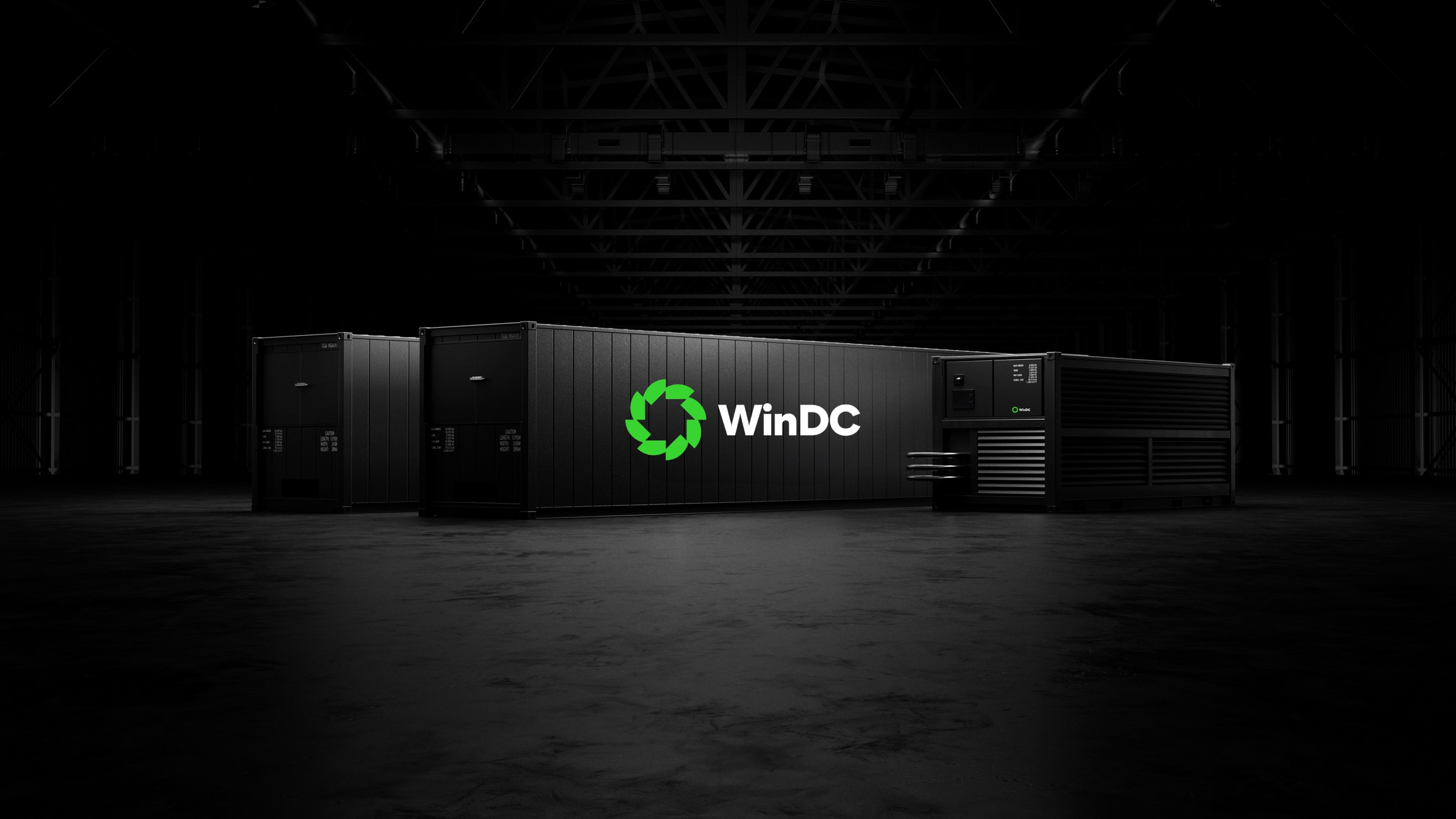
.png)
Andrew Sjoquist has spent more than two decades working directly inside Australia's renewable energy sector. The company he founded before WinDC today connects and secures more than 20 per cent of all renewable energy assets in Australia. WinDC itself — Australia's first portable, modular AI data centre that connects directly at renewable energy generation sites — was founded on a specific observation he made standing on a wind farm in northern New South Wales: clean electricity was being generated and immediately switched off because the grid connection was capped.
Australia has more curtailed renewable energy than its entire data centre sector consumes. It has renewable energy zones generating power with nowhere to send it. And it has a global AI infrastructure market growing faster than the grid can respond. Andrew's argument is that Australia is better positioned than almost any other country to capture that opportunity — and that doing so starts with rethinking not just where data centres are built, but how.
All answers are Andrew Sjoquist's own words, drawn from oral testimony and WinDC's written submission to the NSW Parliamentary Inquiry into Data Centres, 2026. Lightly edited for written publication.
What does a data centre actually do?
"At its core, a data centre converts electrons into photons. Electricity goes in and digital services come out. But around that sits a much broader ecosystem: grid, substations, batteries, fibre, cooling systems, construction, maintenance and skilled operational work. These are long-life infrastructure assets that can help support regional economies for decades if planned properly."
Why have most Australian data centres been built in and around major cities?
"Historically, data centres have concentrated around major capital cities because that was where electricity demand, population of users and connectivity were centred. But Australia's energy systems have changed and our users are now worldwide. Today, increasing amounts of generation infrastructure sits in regional Australia through solar, wind and storage projects."
Data centres occupy significant industrial land in major cities. Is that the right use of it?
"Industrial land in major cities is under significant pressure. Data centres, by their nature, are high in infrastructure intensity but relatively low in employment density. That doesn't make them less valuable, but it does mean they need to be located deliberately. Continuing to concentrate large-scale developments in metropolitan areas will increase competition with other uses and, over time, make siting more difficult."
He is clear that metropolitan data centres will remain necessary — the question is whether they should absorb the majority of future growth:
"None of this means major cities stop being important. They will clearly remain a critical part of the ecosystem, particularly for latency-sensitive workloads. But relying on metropolitan areas to absorb the majority of future growth is going to become progressively harder."
How much of Australia's renewable energy generation is actually reaching consumers?
A significant portion never arrives. When generation exceeds what the grid can absorb or transport, it is curtailed — effectively switched off. Andrew explains the scale:
"In 2025 alone, around 7.2 terawatt hours of renewable energy was curtailed or spilled in regional Australia. That is enough energy to supply roughly two million homes and more than double the estimated electricity consumption of Australia's entire built data centre sector today."
He frames this not as a failure of renewable energy, but as a structural mismatch between where energy is generated and where demand sits:
"Large volumes of renewable energy are effectively being wasted because the grid cannot always absorb or transport it effectively."
What is a Marginal Loss Factor and why does it matter for data centres?
MLF is how Australia's energy market accounts for electricity lost in transmission. Andrew explains the mechanics:
"The further you are from a major load centre, the greater your loss. The loss is called the Marginal Loss Factor, or MLF. It sits somewhere between zero and 20 per cent. Assets close to major cities may have an MLF of a handful of percentages; assets in remote or regional areas, which are particularly constrained, can see losses of up to 20 per cent of generation. In the process of sending power from a regional generation site to a capital city, if you were to generate a megawatt, maybe only 800 kilowatts would arrive."
The industry's standard efficiency measure, Power Use Effectiveness (PUE), doesn't capture this:
"PUE only measures the impact from when electricity passes through the perimeter of the property to when it gets used by the compute. It doesn't take into account all the losses that have occurred along the way from the generation point."
If you looked at the system holistically, Andrew argues, the answer becomes clear:
"Locating your demand and your load where you're generating your power is the fastest way to remove any loss."
"The only way to avoid the grid is to not use the grid, and so co-location is key."
How is WinDC's model different from a conventional data centre?
"What WinDC has explored is an additional infrastructure model, placing appropriate forms of compute closer to energy resources where it makes technical and economic sense. This is not about replacing metropolitan data centres. There needs to be a mix of infrastructure models — different horses for courses. Some applications require low-latency metro facilities; others, particularly large-scale AI workloads, may well be suited to regional locations aligned with energy infrastructure."
WinDC's units are containerised and factory-built, which changes the deployment timeline fundamentally:
"From the time we press the go button to the time the units are commissioned is 90 days. We manufacture them on a supply chain that is in the process of being relocated into Australia. Once they come off that chain, they're fully certified and ready for use. It's very fast compared to building a traditional data centre."
Is the problem where data centres are built, or how they're built?
Andrew's answer is that it's both — and that simply moving large, centralised facilities from metro areas to regional ones doesn't resolve the underlying structural issue:
"The dominant assumption in the market is that future demand will continue to be met through larger and larger, centralised facilities — whether those are located in major cities or moved to regional areas. In our view, that approach carries forward many of the same issues, just in a different location."
WinDC's proposed alternative is a fundamentally different deployment model:
"Rather than treating data centres as single, large assets, we see them as a network of modular, standardised infrastructure nodes that can be deployed across multiple locations. That allows compute to be distributed rather than concentrated, aligned more closely with available energy capacity, and scaled incrementally rather than in large steps. In practical terms, that means a given quantum of compute — say 100 megawatts — does not need to sit on a single site. It can be deployed as a series of smaller, coordinated nodes across the system."
Don't data centres need to be close to cities for low latency?
"The latency argument is wearing very thin, to be honest. The latency between two points in Australia would typically be tens of milliseconds via two or three data centres. The human brain can't detect latency until you get to about 150 milliseconds of delay — that's when you start to notice the lag. System integrations will notice latency faster, but they're usually operating within the same physical facility, so latency isn't a consideration there either."
Can AI workloads actually reduce or shift their power usage, or do data centres need power around the clock?
"That is a conception that has been formed, that data centres need 100 per cent of their power 100 per cent of the time. The loads within data centres are flexible."
Andrew distinguishes between legacy mission-critical workloads and the fast-growing AI category:
"Those mission-critical systems that run hospitals and banks and airlines will continue to need 100 per cent availability. But the growth is coming from AI workloads. If we look at AI workload patterns, they swing wildly in terms of usage. Overall, utilisation sits somewhere around 50 to 60 per cent. That means you've got 40 to 50 per cent overhead built in — capacity that often sits idle."
He points to Australia's existing demand response market as proof the mechanism already exists:
"AEMO has a demand response market where participants can bid their demand into a pool that the market operator can turn on and off as needed. The biggest participant in New South Wales is Tomago Aluminium. They are a demand-response participant that can be turned on and off in various conditions. If a 40-year-old smelter can coordinate itself, I would imagine a modern AI workload could also do so."
"If you have a computing function that you're happy to have delayed by a couple of hours because it's not critical, you will be rewarded with a lower price. Over time, it effectively flattens out demand. That's what grids like — stable, flat demand."
Data centres are known to consume large volumes of water. How does WinDC approach that?
Traditional evaporative cooling works by circulating water through a cooling tower and allowing it to evaporate:
"Heat is moved from inside the facility to a cooling tower outside. The process of evaporating water around the pipes creates the cooling effect. The water disappears into vapour into the atmosphere."
WinDC uses a different system entirely:
"We have gone waterless. We use closed-loop liquid cooling systems, not dissimilar to how a radiator works in a car. In the closed loop system, it's not water in the pipes; it's a refrigerant, which is a little more efficient than water at moving heat."
There is a trade-off in electricity consumption, but Andrew argues it is net positive when transmission losses are factored in:
"The downside is that we use slightly more electricity. The heat has to be rejected somehow, and if it's not going to be rejected by evaporating water, we need to reject it by turning more fans, which takes power. We think that preserving the water is more important than consuming a little extra power, particularly where we're not incurring MLF losses anyway."
"If we're consuming electricity on the generator side of the grid, we're avoiding the MLF. Let's say we're avoiding 10 per cent of losses on average — it would only increase our power usage by maybe one or two per cent. Net advantaged over bringing power all the way to a metropolitan area and incurring those losses."
This approach is grounded in a broader design principle:
"We've pursued waterless and low-water cooling approaches because we believe future infrastructure must work alongside the needs of regional communities, agriculture and local environments."
If data centres move into regional renewable energy zones, what happens to connectivity?
Australia's fibre infrastructure is more extensive than many people realise, including well into the regions. Andrew points to a structural advantage specific to Renewable Energy Zones:
"Australia has invested for decades in fibre-optic cable systems that run across the country. As we move into the regions, those systems penetrate there as well."
"The final builder and owner of communications infrastructure in these zones is actually Transgrid themselves. The transmission network service provider runs a fibre-optic network used to control the switches at remote substations. Those assets are going right into the REZ, built as part of the high-voltage transmission cables."
What does co-locating compute with renewable generation mean for regional communities?
"Done properly, this can create highly skilled regional jobs, support local contractors and suppliers, strengthen regional infrastructure investment, and allow regional communities to participate directly in the growth of the digital economy, not simply watch it concentrate back to the capital cities."
Andrew has also argued for a specific policy framework to accompany this investment:
"I've had a view for some time that a Digital Economic Zone should go with each Renewable Energy Zone — a DEZ alongside each REZ. It would also reduce the need for transmission to be built in the backhaul. Perhaps if we moved the demand closer to the generation, we wouldn't need to move as much electricity back into the metro area."
Does it matter economically where a data centre is located?
The submission makes an explicit argument that location decisions are not simply infrastructure or planning choices — they carry compounding economic consequences:
"Data centres are often described as enabling infrastructure, but increasingly they are part of the economic base itself. Where compute is located starts to influence where AI workloads are developed, where digital services are delivered from, and where adjacent industries choose to locate. That creates a compounding effect over time. Decisions about where and how data centres are deployed are not just planning decisions — they are also economic development decisions."
What needs to change in how governments plan and approve data centres?
"The current planning framework does a reasonable job of assessing individual projects, but it is not particularly well suited to shaping system outcomes. There is no clear mechanism to coordinate multiple developments across a region, or to align development with the forward build-out of transmission infrastructure. That tends to result in clusters forming where capacity happens to exist, rather than where it is optimal in a system sense."
His recommendations focus on three areas:
"Planning frameworks need to be able to accommodate multi-site, networked developments, rather than assessing each facility entirely in isolation. Energy policy, particularly around Renewable Energy Zones, can be extended to consider not just generation and transmission, but also how large, flexible loads are integrated. There is also an opportunity to support standardisation, which in turn reduces approval friction and improves delivery speed. None of this requires a complete redesign of the system, but it does require recognising that the form of infrastructure is changing, not just its scale."
What is the broader opportunity for Australia in global AI infrastructure?
"Australia has a genuine opportunity not only to support domestic demand but to participate in a rapidly growing global AI infrastructure market — a huge export opportunity for the country."
Andrew frames this as a question of system-wide thinking, not facility-level optimisation:
"If you looked at the system holistically — and I think we need to — and considered the losses and inefficiencies that exist system-wide, then location is the fastest way to resolve that."
"We can't as a society say that losses in the grid are someone else's problem. It's all of our problem. A system-wide approach needs to be taken, rather than giving a particular building a tick of approval and pretending the problem belongs to someone else outside the perimeter of your property."
The WinDC opportunity
Australia's renewable energy zones are generating more clean power than the grid can move. The result is curtailment at scale, transmission losses that standard efficiency metrics ignore, and growing pressure on metropolitan grid infrastructure that takes a decade to augment.
WinDC was built for exactly this problem. By deploying modular, containerised AI data centres directly at the source of renewable generation, WinDC converts stranded energy into productive compute capacity — operational in 90 days, running on 100% renewable energy with zero Scope 2 emissions verified at the workload level, and no water consumption.
For renewable energy operators sitting on curtailed generation, for enterprises seeking to repatriate workloads onto sovereign Australian infrastructure, and for AI platforms looking to scale carbon-neutral GPU capacity, the conversation starts here.
WinDC's position is that this shift is both necessary and achievable.
Get in touch here: windc.ai/contact